
Kickoff recap · Capacity · 1:55 p.m.
The Alberta firms he worked with reached the next scale by selling, not by scaling themselves.
He spoke as an industrial designer, from his own career, and he is based in Alberta. Industrial design, as he defined it, is the design of products for manufacturing: the chair, the pen, the automobile, the cement mixer.
Three companies. Each reached the limit of what it could design and manufacture locally. Each then sold to a multinational that already had design resources, and designed the next generation from there.
- Chariot Carriers made child bicycle trailers you can tow behind a bike, and built an international presence. He worked on components, including the Wing, plastic wheels, and hitches. Thule bought the company.
- Tenet Medical Engineering develops products for orthopaedic surgery. Smith & Nephew bought it.
- Dynastream Innovations made personal activity monitors just outside Calgary. Garmin bought it.
His question: can Canada scale AI, or manufacturing, in a way that makes it a player on the world stage?
His history of the Auto Pact starts in the early 1960s. Canadian plants made standard transmissions. The United States was moving to automatics, and that expertise was not here. Canada put a 25 percent tariff on cars entering with automatic transmissions. The United States disliked the tariff. The two countries negotiated the Auto Pact, which became NAFTA, and then its most recent form.
Expo 67 is when Canada came of age in design. The Maple Leaf flag was two years old. Out of that expo, the International Council of Societies of Industrial Design was founded and headquartered in Montreal. It is now the World Design Organization. The push through the 1960s and 1970s was to lead Canadian industry by design. By the 1990s, he said, China had become the world's manufacturer, and the dynamic changed.
Canada is a medium-sized nation with a small population, and scaling manufacturing is hard. It is a place of innovation. More often than not, he said, that innovation is bought by an international firm that can take it further.
Three questions he left for the 2080 horizon.
- What does scaling AI in Canada look like over that time?
- Is there a way to use it in many different ways?
- What will it take to support it, and is there a Canadian perspective on how the industry unfolds?
Full Transcript
Cleaned up transcripts.
Keynote
Thank you for that kind introduction. Thanks, Francis, for inviting me to join you folks today.
Today I will be speaking as an industrial designer, sharing some ideas from my own perspective on the question of scale. This arose within my own career going back a number of years. I don't know how familiar people are with industrial design, so maybe I'll back up and give a quick introduction. Industrial design is the design of products for manufacturing. It includes everything from the chairs you're sitting in and the pen you're using, all the way through to automobiles, transportation, cement mixers, and all manner of artifice that is manufactured.
Going back a few years, I worked for three Alberta-based companies. I'm based in Alberta myself.
Chariot Carriers. They designed child bicycle trailers that you can tow behind your bike. They managed to create an international presence with their product. We designed a number of components that were part of their overall product line, including the Wing on the side, plastic wheels, and hitches.
Tenet Medical Engineering. They develop products for orthopaedic surgery.
Dynastream Innovations. They were doing personal activity monitors based just outside of Calgary.
Each and every one of these companies reached a certain point in their scaling based on what they could design and manufacture locally. Correlation doesn't equal causation, but it is an interesting observation that they were all able to leverage the work they had done to get to next-scale production. However, they did not do this by scaling themselves, but by selling to multinationals.
Chariot was bought by Thule.
Tenet was bought by Smith & Nephew.
Dynastream was bought by Garmin.
Once acquired by those larger entities, which already had design resources, they were able to design for the next generation of products by accessing those international-scale resources.
For me, this raises the question of scale. Is Canada able to scale in an appropriate way with regards to AI, or almost any aspect of manufacturing, and understand what it takes to be a player on the world stage?
It's interesting if you look into the history of Canada. Going back to the 1960s, the reason we had free trade was because of automatic transmissions for cars. In the early 1960s, Canada's auto manufacturers basically manufactured exclusively standard transmissions. The US was moving ahead on automatic transmissions, and that expertise did not exist in Canada. In fact, Canada had a 25% tariff on US cars coming into Canada with automatic transmissions.
It's an interesting historical precedent. The US didn't like the tariff situation, so Canada and the US negotiated the Auto Pact. The Auto Pact eventually evolved into NAFTA, and into its most recent iteration.
The other big thing that happened in the 1960s was Expo 67. What's really interesting about that is Canada was seen internationally as coming of age in a design sense. The Maple Leaf flag was two years old at that point, and Expo was a way to showcase Canada as a world leader in design. Coming out of that, the International Council of Societies of Industrial Design was born and headquartered in Montreal, now known as the World Design Organization.
There was a big push coming out of the '60s and '70s to advance Canadian design as a way of leading Canadian industry and scaling. How do we make Canada a fantastic manufacturer? What ended up happening, though, was China became the world's manufacturer in the 1990s, leading to a very different dynamic.
When we look at the historical roots of how manufacturing has evolved within Canada, we recognize that as a medium-sized nation with a small population, it is actually very difficult to scale the manufacturing atmosphere. Canada is a bastion of innovation, but more often than not, that innovation is acquired by international entities that can scale it to the next level.
Given the conversation around AI and understanding the future thresholds for Canada 2080, there is a very compelling investigation required. What does the scaling of AI look like in Canada over that time horizon? Is there a way to leverage it in many different ways? What is it going to take to support it, and is there a uniquely Canadian perspective on how this industry unfolds over the coming decades?
Thank you very much.
Panel
Francis Wang asked the questions.
How do we know we are making progress as a country?
To fit right in, one of the things that I've always been struck by is our comfort as a smaller player, going back to the point Sebastien was just making. Canada is so rich in resources that we've become very comfortable selling those off. We're not the manufacturing or innovation leaders that Korea, Singapore, or Scandinavia are.
The issues we're running into now put Canada in a position to really become clear about what its interests are as an economic power and force in the world. To Greg's point about measurement, we've got to understand what our interests are to then begin blocking out what's important for us as a country and measuring those things. We have to step out of a small player mentality and start thinking more like where Canada was back in the 1960s, where we can see ourselves being a world leader.
What about Monday?
First off, I want to argue for starting Tuesday. Monday is heart attack Monday, and I'm already busy that day anyway.
Reiterating what Greg was saying: having that vision, understanding the target, and applying the sustainability argument of act locally, think globally. There's an opportunity here to think strategically: what are the interests at play with any given endeavour, and what are the smaller moves we can make within our lives and entrepreneurial forays to push that forward? Understand that every small move is actually part of a conversation towards those larger missions we establish for ourselves.
At the kickoff
-
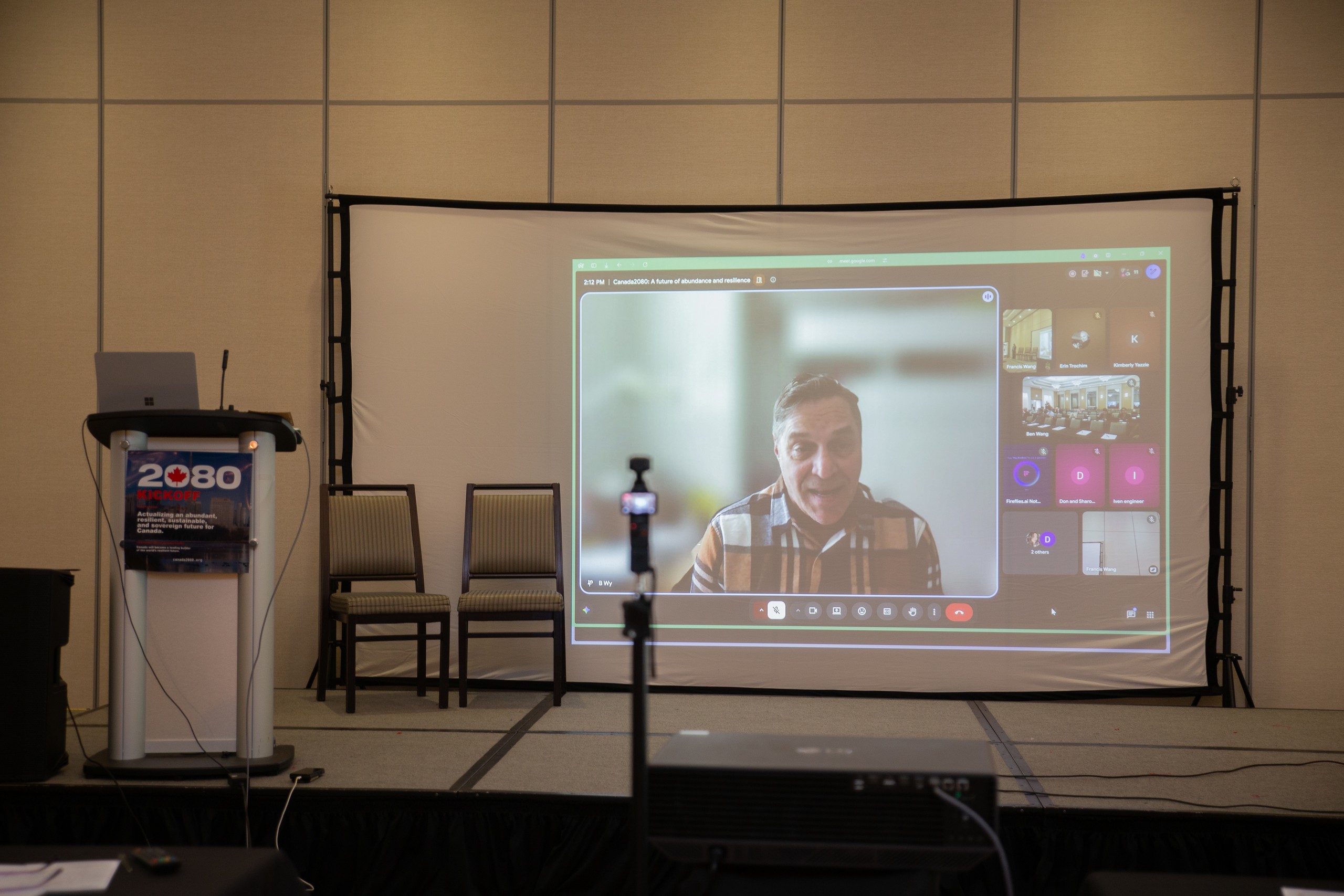 On the screen.