
Kickoff recap · Opening and close · 1:10 p.m. and 2:30 p.m.
Canada is the future of the planet.
He called the afternoon a kickoff, not the multi-day launch a claim of this size would usually require. Canada2080 is a long horizon. The point of the day was to gather people who believe in similar possibilities, start the conversations, and hold many more.
Looking forward from today, he named what is already in hand: land, freshwater, rare earths and biomaterials, clean power, research institutions, and a strong zero-to-one. The failure is commercialization and scale. Intellectual property goes to foreign corporations. Educated people leave. Raw materials are sold instead of becoming local supply chains. He called that a trade of intellectual culture and resource value for cheap money. We specialize, he said, as a plantation for the world.
His picture of how the value leaves: American industrialists built the oil pipelines so the industry stayed in America. Today, entrepreneurs make the money in the Bay Area, then sometimes fund training institutions in Canada whose talent is funnelled elsewhere.
The ambition in front of that failure is resilient living systems, manufacturing brought back, an integrated supply chain, and chips made here. By then, he said, they would probably be quantum chips. It took Taiwan 40 years, in his account, to lead in chip manufacturing. These things are feasible if the country aims at them.
Then he looked backward from 2080. On current models, 3.8 billion people would be living outside the human climate niche and would need to go somewhere. The equal-earth projection, recently adopted by the UN, shows little land in the Southern Hemisphere. Climate-based migration moves north, toward countries less affected by rising coastlines. He said Canada will host the world's people. The population that arrives, he said, is what makes the density patterns he associates with Asia possible here, and what supplies the workforce for a domestic supply chain.
Selling resources and culture brings revenue and exchange. Retaining capability keeps the means to build and operate. Retaining ownership and decision rights keeps the choice of direction. Retaining learning and reinvestment keeps one success connected to the next. He said Canada needs all four.
AI and infrastructure are tightly coupled, on different timescales. Since industrialization, scale has required energy. With agentic AI, he argued, scale also requires compute, and still more energy. He does not know the next turn. It could be quantum computing, or reconfigurable surfaces in advanced materials. He quoted Carney, from forward guidance the month before: "Controlling our energy means controlling our destiny."
The form he imagined is neighbourhoods that generate their own energy and compute, produce their own food, and manage their water. A household keeps health data, finances, and private records on local compute, while that same capacity serves the connected system for less sensitive work. He ended the opening on dial-up and cable modems, as a computer science graduate from Waterloo. Every modem was a physical piece of a network with no form. Parents who had bought gaming computers, he said, had already invested in Canada's infrastructure and sovereign assets. The work has started, in small steps.
He closed in English and in Chinese. An aunt had told him these events are always in English, and difficult for her. His parents were in the room. He asked guests to carry the ideas into their own communities. A He closed the session with two sayings that capture the essence of the day. A plaque at Waterloo's Conrad School of Business says that to go fast you go alone, and to go far you go together. The value, he said, has to come back to the people who struggled toward it. It takes grit and luck. He used "Better run than curse the road," and 与其感慨路难行,不如即刻出发. We, the North, are a strong people. We know tough winters, how to keep stock, and how to provide for one another. Winter will pass, and we will welcome spring.
Full Transcript
Cleaned up transcripts.
Opening
Good afternoon. To everyone joining in person and online, thank you for coming to the kickoff of Canada2080.
Normally, a launch at this scale would be a multi-day event. Each of the guests invited today would have a much longer keynote, followed by hour-long panels, if we were to do this properly.
As the name suggests, Canada2080 is a long-horizon initiative. My intention today, in calling a kickoff, is to gather people who believe in similar possibilities, to start conversations, and to hold many more events.
I have been thinking about bold ambitions, and claims, to rally behind and to put purpose to the struggle. For Canada to be one of the most prosperous nations by 2080, and to say that Canada is the future of planet Earth.
Let us begin by looking forward from today.
Canada has strong foundations. Land, freshwater, rare earths and biomaterials, clean power, and a home for some of the most innovative education and research institutions in the world. We have the natural capital, and a strong zero-to-one in almost everything.
We also have our issues. Today, Canadian firms often struggle to commercialize and scale. Intellectual property goes to foreign corporations. Educated people leave Canada for opportunities elsewhere. We sell our raw materials instead of building the capabilities and the supply chains for a thriving local economy.
The American industrialists were smart. Back then, they built the oil pipelines so the industries stayed in America. Today, the smartest entrepreneurs and innovators flock to the Bay Area, make the money, and then sometimes feel it is time to contribute. They bring money back to build more training institutions, which end up building talent in Canada to funnel elsewhere in the world.
We are trading our intellectual culture and our resources, the value, for cheap money. We specialize as a plantation for the world, without deliberately building the infrastructure for ourselves.
But we are rich in this zero-to-one, and the opportunities lie in front of us. To build resilient living systems. To bring back manufacturing and an integrated supply chain. We can make our own compute chips, although by then they will probably be quantum chips. It took Taiwan 40 years to become a leader in chip manufacturing. These big, ambitious things are feasible if we aim for them.
Now, let us look backwards from the future.
Canada is the future of this planet.
By 2080, 3.8 billion people will be living outside the human climate niche, based on current models. These people need to go somewhere. If you look at the world map, the equal-earth projection recently adopted by the UN, there is not a lot of land in the Southern Hemisphere. Climate-based migration will move northward, to countries that are not as affected by rising coastlines. That leaves Canada and Russia to host the world's people.
What is interesting about this future is that, some time along the way, there will be climate-based immigration and a corresponding increase in population in Canada. That enables business models and patterns in Asia which depend on a higher population density that cannot be replicated here. We will also have the workforce to support that integrated supply chain.
So there is a picture. What can we do to actualize it?
A country can sell resources and still lose the higher-value capability around them. It can export culture and still lose the ownership, distribution, and learning that allow culture to compound. It can produce brilliant research and still see the decisions, production, and reinvestment happen elsewhere.
The distinction is simple, even when the work is hard.
Selling resources and culture brings revenue and exchange. Retaining capability keeps the means to build and operate. Retaining ownership and decision rights keeps the right to choose a direction. Retaining learning and reinvestment keeps each success connected to the next generation of capacity.
Canada needs all four.
Our first panel is on AI, and the second is on infrastructure. I believe these two are tightly coupled, although we address them on different timescales.
Since industrialization, everything we do at scale requires energy. AI is critical at this moment because, with agentic AI, I will argue that everything that happens at scale from this point on will require compute, and with that an even greater demand for energy. I always tell people I do not know what the next turn will be. It could be quantum computing, or reconfigurable surfaces in some advanced materials. Whatever it is, it will need even more energy, even more compute, and whatever the new thing will be. That is building strong foundations.
This is in line with our current national strategy. Carney stated, in his forward guidance this past month, and I quote: "Controlling our energy means controlling our destiny."
We need to build capacity in Canada in a way that is resilient. Resilient systems are made of resilient parts, with connections across scales. AI is making complex systems possible at a small scale, because management is cheaper. So perhaps we could build new neighbourhoods that generate their own energy and compute, produce their own food, and manage their water. These resilient parts come together as a resilient society.
I will end this introduction with some of my current work, from decentralized energy, and bringing that to decentralized compute. I imagine a prosperous future in which every household can manage some of that complexity. Your family's health data, financial information, and digitized private assets sit on local compute in the household, while that same capacity serves your connected systems for less sensitive work.
Show of hands: how many people remember dial-up modems? That nostalgic connection noise, which I will not replicate, though I could. It is noisy and it takes forever. Then came cable modems. Sometimes you had to unplug them, plug them back in, and wait before you were online. Why is it so slow?
As a computer science graduate from Waterloo, I will tell you what is fascinating about these things. Every piece of those modems was a physical part of the internet. A concrete presence of something with no form. It has to communicate and join a complex network of billions of devices. So I understand why it takes some time. And I still complain that it is so slow, because users do not care about that.
Why I bring it up: I see younger people here, and parents with children. If you bought, for yourself or for your children, one of these now very expensive gaming machines, I thank you for investing in Canada's infrastructure and sovereign assets. We have already started, in small steps. Let us turn to AI, and to our guests. Thank you.
Closing
Thank you, Kritika. Thank you to all of our guest speakers for a barrage of information. Time flew by.
We are in Markham. One of my aunts has always told me that these events are always in English, and that it is difficult for her. My parents are here too, and I know it is difficult for them to understand what I have been saying.
So I will try to close, and to make the invitation, in both languages, so people can know how important this is, and how noble the pursuit is. If you are willing to invest the time, help do that in your own communities.
我燕姨一直说这些活动都是用英文讲的,她其实也听不太懂。所以今天我就试试中英双开。我小学三年级的语文水平啊,大家见笑了。
In the Conrad School of Business at Waterloo, there is a framed plaque that says, "If you want to go fast, go alone. If you want to go far, go together." I believe that sums up today. An initiative of this magnitude requires coalitions, partnerships, and a common belief in a future to co-create and actualize, and to benefit from the value realized by that future, for all those who struggled toward it.
我们滑铁卢大学的一个商学院里面有这么一个poster,说独行快,众行远。我个人觉得这句话很好,也很符合今天我们讲的那些东西。要想把一个50年的远景做出来,不是一小群人可以办到的事情。我们需要团体和合作,以及共识的理想,去实现这些未来。才能在这个未来成真之后,能把它带来的财富给予在实践路上的这些人。
Actualizing the future, and building Canada into a strong, sovereign nation on the global stage. For all our excitement and passion, it is a long and arduous journey. It is difficult. It takes grit and luck. As the old saying goes, fortune favours the bold.
There is another phrase I like. I believe it is a Western idiom: "Better run than curse the road." Honestly, it sounds a lot cooler in Chinese.
Providence favours those who persist despite failures, continue despite adversity, and still carry on despite being tired. They are favoured. We are favoured, because we have a kind of resilience that comes from having a deeper purpose, a why that propels us to press onward and stay restless in the pursuit.
So difficult as it is, the difficulty itself is of no concern. We knew about the difficulties before we started.
我们这次打出这么大的口号,要把加拿大这个国家做成世界强国。难。真的很难。我们需要很大的韧性。而且光是韧性还远远不够,我们还需要运气。但话说回来了,有些运气是可以人为的。上天眷恋什么样的人呢?上天眷恋那些失败后还能继续的人,那些受挫折但仍然坚持的人,和那些累、但脚却停不下来的人。这些人会被眷恋,因为这些人他们停不下来。他们停不下来,是因为他们背后有更大的意志和理想驱动着他们。
所以难不是问题。因为我们在启程的时候就已经知道这条路很难了。
"Better run than curse the road."
与其感慨路难行,不如即刻出发。让我们风雨兼程,笃行不怠。也祝我们一往无前,所向披靡。
"Better run than curse the road."
We, the North, are a strong people. We know about tough winters, how to be resourceful, how to keep stock, how to provide for one another in tough times, for when the table turns and we need help. It takes a community. But winter will pass, and we will welcome spring.
I invite all of you to join this initiative, and together we will build a sustainable, abundant, and resilient Canada. Thank you.
Panel questions
Panel 1. Kritika Saihgpaul introduced the panel. He kept the round short.
What is the first distinctive thing we can do by borrowing from patterns abroad? We see how other places handle AI and sovereign governance. What are the patterns we can accommodate in Canada?
Erin, Kimberly, can you offer observations from abroad, or from other communities, that Canada should adopt?
What evidence should decision-makers demand before calling an AI deployment here safe, secure, trusted, or publicly beneficial?
Panel 2
He asked the questions, and he closed the round.
I'm the least qualified to talk about this stuff, so I kind of always ask questions. I'll tell you this. Two questions, because time is constrained. But the second question I'm dying to know more about, and to get your brains on, is actually the start, right? What happens tomorrow? So that's the second question.
This first question, I don't even know, I'll anchor this here and then we'll take it: recognizing progress, right? How do we know we're even making progress as a country? What signals can we find, whether 10 years out or shorter term, to suggest that we're not just doing isolated projects where people are on different islands not really collaborating, or multiple well-meaning people all trying to do something without technology? How do we know that?
Someone in the room said, we just measure GDP.
That's definitely not the answer.
With every disruption there's opportunity, right? So, you already know what I'm going to ask next: what about Monday? Are we measuring more stuff on Monday? What are we heading for first on Monday?
Thank you, Barry. I have some thoughts too, hearing all these perspectives around what I plan to do tomorrow. As Barry said, there are multiple scales of things.
A few things come to my mind. One is that we should host more events like this. The reason for this kickoff is that we're going to do more of this, but in general, at every scale, from federal-level conversations and economic summits, to having more hosted in Canada rather than Canadians just attending elsewhere. To that point, we can build these trade collaborations where we bring raw materials in, do the manufacturing, and build our own economy that way. There are countries willing to collaborate like that.
The people who were part of this conversation know this was put together very quickly. Starting tomorrow, planning for the next couple of months, maybe next spring or fall, let's do something much bigger. Let's do something that is more of a national, federal-level engagement with different governments around how to bring back building in Canada. Let's aim for that starting tomorrow.
I know I want to make phone calls, and we can celebrate Sebastien having successfully won the request for proposals for Alberta.
Okay, I think that should be all the time we have. Thank you so much for sharing these perspectives. I'll do a quick closing next, and then there will be networking.
At the kickoff
-
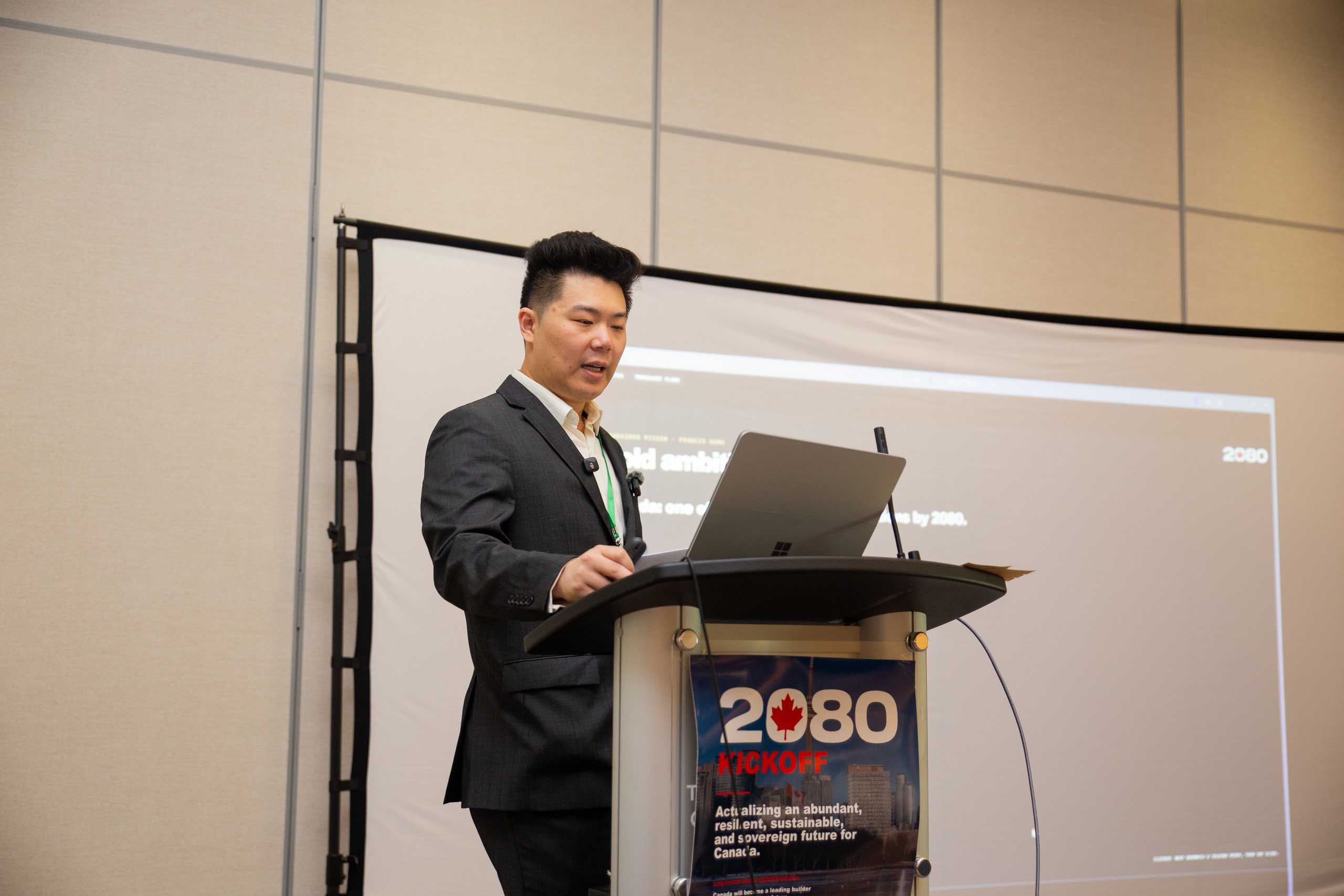 The long-horizon challenge.
-
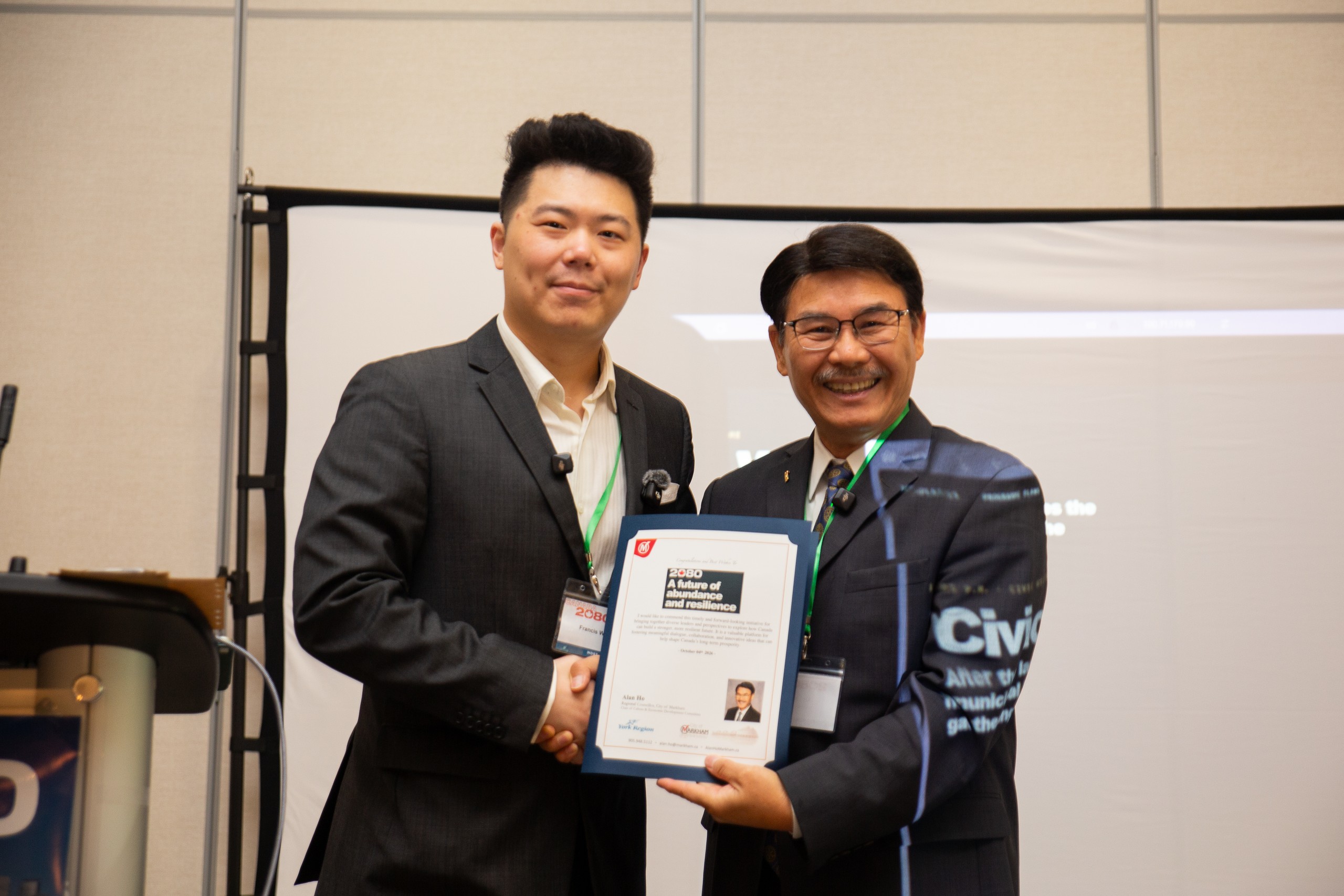 With Alan Ho and the City of Markham proclamation.
-
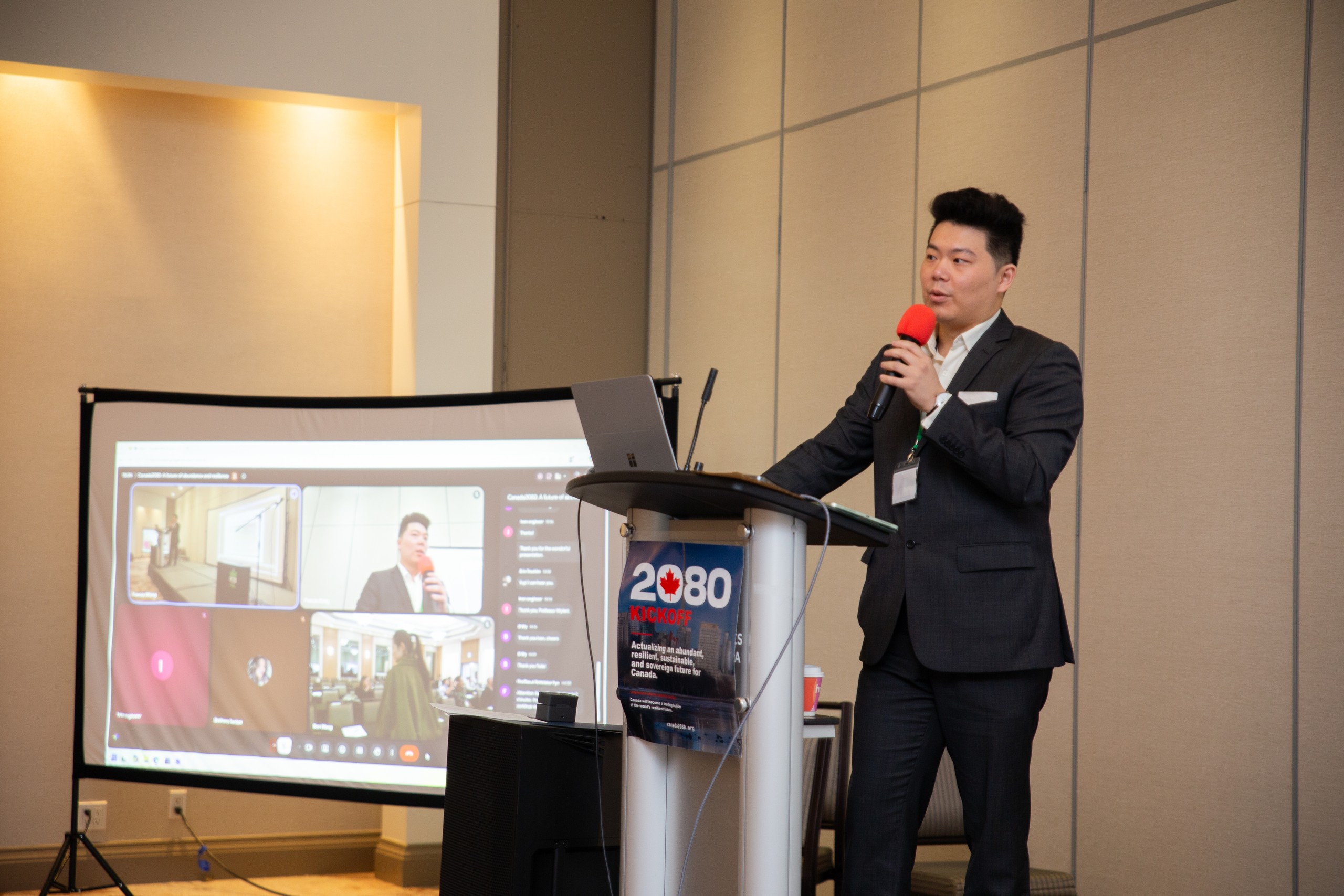 Closing the afternoon.