
Kickoff recap · Capacity · 1:55 p.m.
2080 is not a problem to be solved. Know where you are going, know where you are, and start Monday.
He works closer in than 2080, and this question is the centre of that work. Easy problems should be solved. The challenge of the country's potential is different. If someone calls it a wicked problem, his reply is that it is not really a problem. It has to be thought about another way.
His picture was a boat loaded with containers of beliefs and assumptions. The future is a process. It never arrives, and a static point in it is dangerous. VUCA, volatility, uncertainty, complexity, and ambiguity, has been around for twenty years. He said it describes the future, today, and the past. We feel it more now.
The same thinking produces the same results. He cited Sidney Dekker on the drift into failure: you wake up and it has already gone, and it took a long time to get there. The danger is not only missing something remarkable by 2080. It is arriving at something remarkably bad.
He borrowed Warren Buffett, riffing on Socrates and Buckminster Fuller. If the boat is leaking, look for a new one. Keep fixing the holes you have. Also find a new paradigm. There are no broken systems. A system produces the patterns it produces. If you dislike them, rework it from a new way of seeing. That is strategy, not a map, and potential, not a problem list. The question is what could be created.
Design, as he defined it, is creating the conditions for success. You have to know what success looks like, and you have to know the soil things will grow in. People say Canada does not move fast enough. He agrees. The current Prime Minister wants major projects approved quickly. Speed, he said, is not the design goal. It is what low friction produces. Friction means the paradigm is poor.
Apollo, for him, was a mission built on potential, not a narrow answer to Sputnik. Many technologies in use now came from it. He offered it as a way government can shape a market around potential.
The paradigm he wants, including from an Indigenous perspective, is a living system, because life creates the conditions for more life. Living systems run on potential and relationships. They do not choose quantity over quality, or the highest energy option. They keep what works and still invest in what would be different. A living system has to be competent. Competence is know-how.
If more of the world's people are coming, as he heard Francis suggest, the places they live in matter. Utrecht built an expressway into the middle of town in 1980 and later retrofitted it. Places can be made better. Ignore what you are putting together, he said, and the result is a Blade Runner future.
Education, in his view, is outdated for this work. Rewire it around critical thinking, systems thinking, and computational thinking, not facts to be returned on a test. Make it experimental, and a form of play.
Four things that work has to know.
- What patterns do we want?
- What conditions do those patterns need?
- What actions support them?
- How do we measure that we are on the track?
He called that relentless pragmatism. Know where you want to go. Know where you are, without romance. Know what it takes to get from here to there. If the horizon is 2080, start Monday.
Full Transcript
Cleaned up transcripts.
Keynote
Hey everybody. Thanks for inviting me, Francis. It is great to be here.
2080 feels like a long way away, so you'll see me talk a little bit more about things that are closer. All the things that I'm involved in are all related in some way really to this topic. This is the centre of the work that I do every day, all day.
And so I'd like to talk to you today about a few basic ideas for how we might think about this going forward, starting with this idea of: we should just stop solving problems. Of course, there are some problems that are easy to solve, and we should solve them. But a lot of the challenges, the challenge we're talking about today, is not a problem-oriented challenge. What we do to create the potential of this country for 2080, some people would call it a wicked problem. My response would be: if it's a wicked problem, it's not really a problem. It's something we have to think about in a completely different way.
So, there we go. I took this picture myself. No, I didn't. But this is a picture of the future. That's what this is. It's a picture of the future, and we can add to the future us. That's us right there at the bottom in the boat filled with containers. Those containers are filled with all sorts of beliefs and assumptions that we have about how the world works and how we work in that world.
That is the situation that we find ourselves in. You know, there are all sorts of acronyms that explain this in different ways. This is a popular one. It's been around for 20 years or more now: the notion of VUCA. These things are all true about the future, they're all true about today, and they're also all true about the past. We're just feeling the pain of this a lot more today because of a lot of the changes that have occurred.
And remember, the future is a process. It never arrives. So if we think about a static point in the future, it can be a little bit dangerous.
Here's another thing to think about when we think about all those containers that are on that ship: the same old thinking leads to the same old results. It's what my friend Sidney Dekker in Australia calls the drift into failure, where all of a sudden you wake up one day and everything's gone to shit, and you're wondering what happened, and it took a long time to get there. We are in danger of that situation right now, let alone achieving something remarkable by 2080. Actually, avoiding something remarkable and negative by 2080.
Warren Buffett is somebody you've probably heard of, and I love this. He's basically riffing on Socrates and Buckminster Fuller here by saying, hey, you know what? If you're in a boat that's leaking and things are not going well, you should spend some time looking for a new boat. Which isn't to say that we stop fixing the holes in the boat that we have for the moment, which is problem-solving, but we need to look for a new boat. That means a new paradigm, a new way of looking at the world.
And remember, there are no broken systems. This is language we hear all the time: oh, the system's broken. It's not. It's just producing patterns you don't like. If that's the case, then think about how the system can be reworked from a new paradigm. It isn't about setting out plans. It's not about maps to the future. It's about strategy. It's not about problems. It's about potential, thinking about what could we create?
In order to do that, we have to think about context. For me, design is really a simple thing: it's creating the conditions for success. Design requires us to know what success looks like, and it requires us to understand the conditions that will bring about that success. That's a long way from a narrow, problem-solving kind of approach.
Which means that we need to think about the context. What is the soil that we are creating in order for things to grow in? For instance, people say things don't happen fast enough in this country. I completely agree they don't happen fast enough. The current Prime Minister is quite concerned about getting major projects approved quickly. But speed itself is not actually a design goal. Speed itself is a byproduct of good design. If things are put together in the right way and the right kind of potential is being created, things will naturally go fast with low friction. If there's lots of friction, it means the basic paradigm is poor.
I put this slide here to show you that it's possible for a bunch of middle-aged or older white guys to get into a room and something cool could happen. I'm referring here to the Apollo missions from the 1960s. The Apollo mission was a potential-based mission. It was not a problem-solving mission. You could say it was about solving the problem of the Russians getting Sputnik into space, but that would be a very narrow definition. Many of the technologies we use today came from this mission. I would say that it's really interesting to think about this as a way of shaping a market. When government thinks about how to participate, shaping markets around potential is a huge potential for them.
The paradigm we need to connect with, or reconnect with if we think about the Indigenous perspective, is a living systems perspective, because life creates the conditions for more life. That's what we're talking about in this kind of world. Living systems are based on potential and relationships. They never choose quantity over quality. They never look for the highest energy option. They always look for the lowest energy option. They're interested in options. They want to maintain and operate the things that are working today, but they also invest energy in the future, in things that are different than today, what new value would look like. This is an important paradigm that we could think about.
One of the most important things coming out of a living system is it has to be competent, because if it's not competent, it's not a living system. Competence is fundamental, and that's know-how.
If we're going to deal with a future like this, we need to learn how to surf. There are two things I want to highlight here. One is the places that we live, because this is the context for humanity. If we're talking about half the world moving to Canada as Francis seems to be suggesting by 2080, the places we live are important. This is a picture of Utrecht in the Netherlands in 1980 where they built this horrible expressway into the middle of town, and they've retrofitted it back to the picture you see on the right. It's possible to improve the quality of places, using living systems principles in order to create better places to live that are more successful so that we don't end up in a Blade Runner future, because Blade Runner is what happens when you don't pay attention to what you're putting together.
Learning is a huge challenge. Our education system right now is completely outdated for the challenges that we're talking about. It has to be completely rewired around fundamentals like critical thinking, systems thinking, and computational thinking, not bits and pieces of facts and factoids that get thrown at us and that we have to regurgitate onto tests. We should become very experimental, and it should be a form of play, something that we celebrate. These are the conditions that will lead to this kind of prosperity that we're looking for. That means we have to know: what are the patterns we want? What are the conditions that are needed? What are the actions that support those patterns? How do we measure all of that stuff to make sure that we're on the right track?
I would sum this up by saying this is a principle of relentless pragmatism. It means knowing where you want to go, having a clear idea of where we are today, and not being a romantic about it, but actually knowing what's needed to get from here to there. This is something that's missing, and we need to bring it to bear really quickly.
So if we're talking about 2080, I'm saying start Monday.
Panel
Francis Wang asked the questions.
How do we know we are making progress as a country? What signals, in ten years or sooner, would show we are not just running isolated projects?
I'll take a crack at it. I'm actually involved in a project right now that is very focused on measurement around these kinds of questions. Measurement is the key. You have to be able to see what's actually happening with regard to the key principles that you know are going to put us in a position to realize potential.
First, we have to know what we're playing for. I think for a long time we have not had any idea about that. It's all just catch-up, and we've got to be as good as these guys, or how do we hold on to this? It's very much this problem-solving behaviour. So first, we have to know what it is. Second, we have to make it visible. Everybody should be able to look around and see: hey, those things we said are important, are they working or not? Are we doing them or not? Currently, we're just not doing the things that need to be done. So for me, that's a big part.
And we can actually measure how often we do that. That would be important to talk about.
Barry makes such a great point, and I want to tie it to something said earlier about the bear going into hibernation or coming out of hibernation. To me, when the bear really went into hibernation was when we signed the Free Trade Agreement with the United States in the 1980s. It cemented a relationship of absolute comfort and shifted our percentage of sales to one country from 40 or 50 percent to well over 80 percent. It was the thing that allowed us to go to sleep. So hopefully we have woken up, and hopefully we're going to be hungry coming out of the den and do some stuff.
What about Monday? What are we heading for first?
When I used that phrase start Monday, the most important thing is not to push off a timeline, but to actually start. The thing to start on Monday from where we are right now is to build the compass. We have to say: this is the place that we're going, and this is what it requires of us to get there. Then, immediately start doing the little things at whatever scale necessary so that the compass needle tracks to the place we want to go. Know what the principles and conditions are, and know how to start putting those into play immediately.
That way, when Sebastien fills out the request for proposals for that project in Alberta, instead of having to worry about bureaucrats figuring out how not to say yes to something exciting, or using a technology that works well elsewhere but won't work in this situation, we've created the right conditions. Right now, we're nowhere close to that. So when I say start Monday, it means we know what needs to exist to get to the future we want, so let me start living like that on Monday. Even at an individual level, we can start approaching our day with the mindset and practices necessary to achieve the things we want.
Yeah, we'll check on the bear. We already have a measurement suggested for us right now.
At the kickoff
-
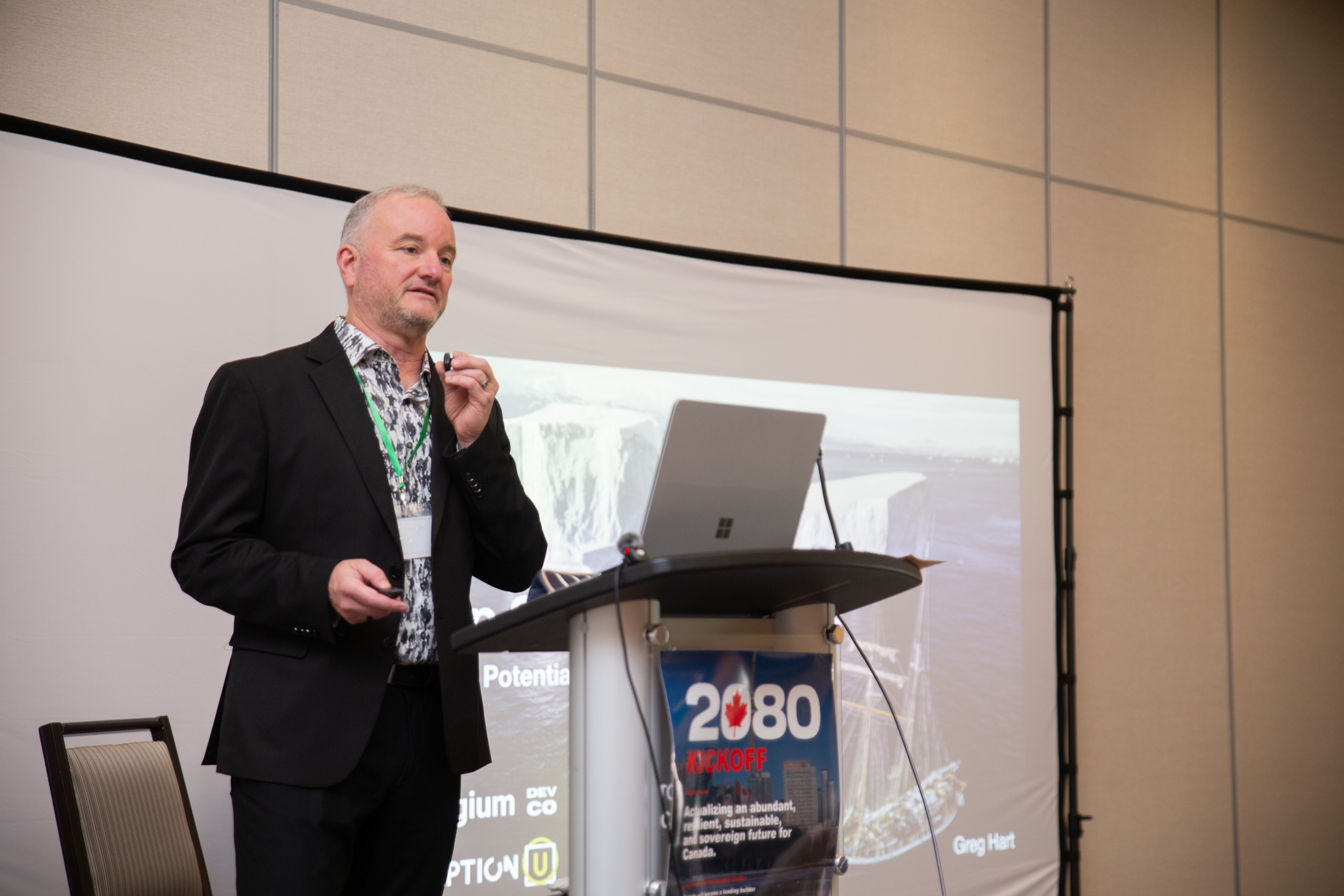 On designing the conditions, then starting Monday.
-
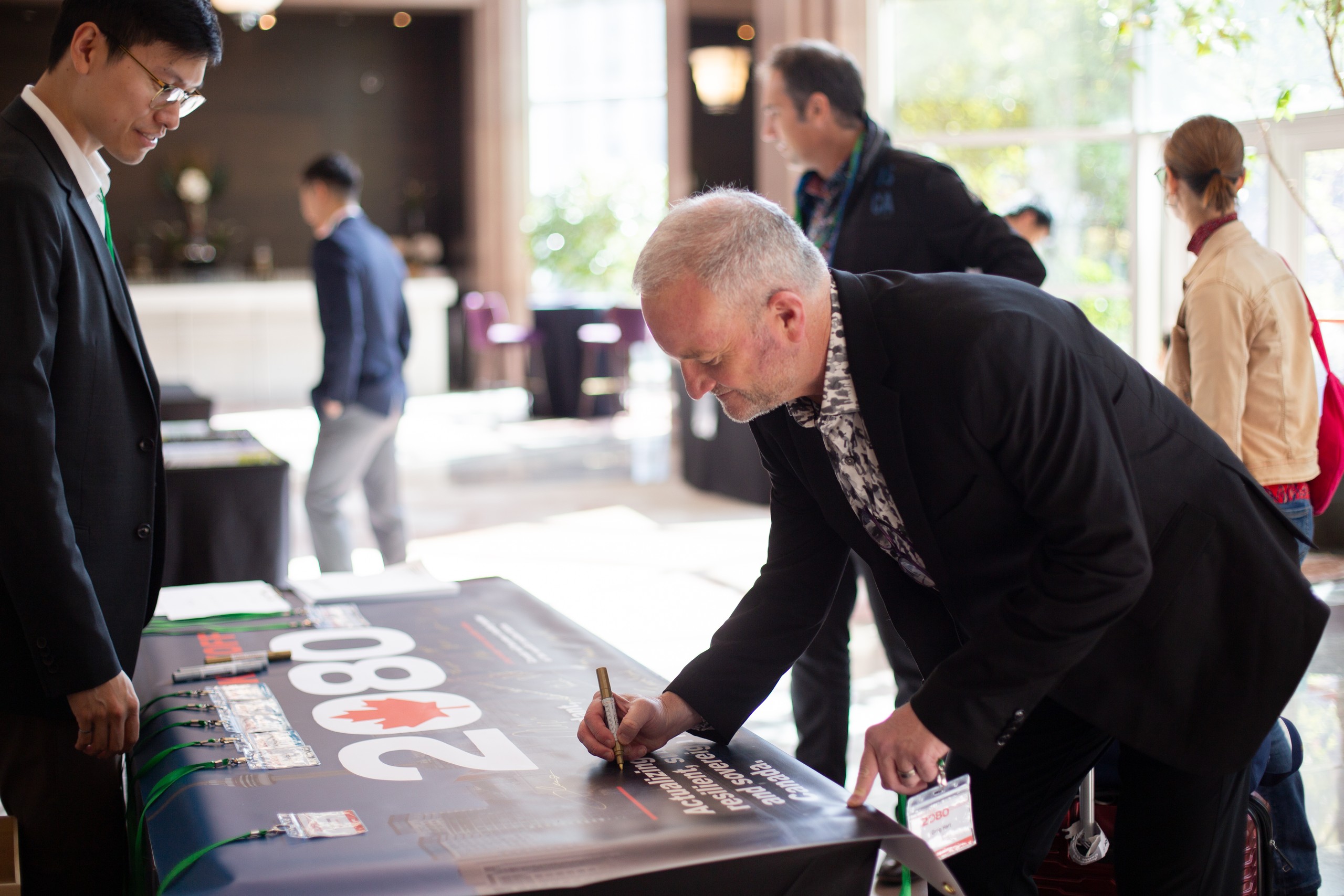 Signing the kickoff banner.