
Kickoff recap · Sovereign AI · 1:20 p.m.
Sovereign AI, she said, is usually a question of who owns the compute, the data, and the models. She asked a different one: for whom?
She spoke in her own capacity, not on behalf of her institution, and thanked the organizers for bringing education, industry, and governance into one room.
For Indigenous communities, she said, AI is a question of relationships. Who decides, who benefits, and who carries the responsibility long after a project ends.
Satellites and sensors watching over a community's land can be a tool for care. Built without the people of that land, the same system can become a sophisticated way of watching them. She said it is not her place to speak for any community. What she can say is that Indigenous data sovereignty and early engagement deserve real support.
Every community can take up a new technology, or not, on its own terms. When a community chooses to step in, that begins with education and partnership from the first conversation, not after the design is finished.
Two commitments make that choice meaningful.
- Consent that stays open. Free, prior, and informed consent is an ongoing relationship, not a checkbox at the start. A community can revisit its choice as the work grows. Data shared along the way stays under the authority of the community it describes.
- Accountability to relationships, not just outputs. Indigenous scholars have long taught that resilience lives in relationships of care and responsibility with land, water, and non-human relatives. AI cannot move in a single direction set from the outside. It has to move with Indigenous governance, and that governance needs real space.
She cited the UNESCO Recommendation on the Ethics of Artificial Intelligence, adopted by member states as the first global standard in AI ethics. It recognizes that Indigenous peoples must take part in shaping AI. The task, she said, is to make room for that in practice.
Her proposal: begin with the partnership, not a product. Build the education, the trust, and the governance together, then see where the relationship goes. Technologies will change. What endures are the relationships each generation carries forward.
Full Transcript
Cleaned up transcripts.
Hi everyone. Thank you Francis. Thank you for that introduction. Thank you to the organizers for bringing education, industry, and governance into one room.
I speak today in my own capacity, not on behalf of my institution.
In some cases, when we talk about sovereign AI, we usually mean who owns the compute, the data, and the models. I want to ask a different question: for whom?
For Indigenous communities, AI is not only a technical question. It is a question of relationships. Who decides, who benefits, and who carries the responsibility long after a project or collaboration ends?
Take a system that uses satellites and sensors to watch over a community's land. It can be a powerful tool for care, or, if it is built without the people of that land, it can become a very sophisticated way of watching them. It is not my place to speak for any community, but what I can say is that Indigenous data sovereignty and early engagement deserve real support.
Every community has a choice to take up new technology or not on their own terms. When a community chooses to step in, it begins with education and partnership from the very first conversation, not after the design or collaboration is finished.
Two commitments make that choice meaningful.
First, consent that stays open. Free, prior, and informed consent is not a checkbox at the start of a project. It is an ongoing relationship, and a community can revisit its choice as the work grows. Data shared along the way should remain under the authority of the community it describes.
Second, accountability to relationships, not just outputs. Indigenous scholars have long taught that resilience lives in relationships of care and responsibility with land, water, and non-human relatives. This means AI development cannot move in a single direction set from the outside. It needs to move in tandem with Indigenous governance, with that governance acknowledged and given real space.
The UNESCO Recommendation on the Ethics of Artificial Intelligence, adopted by UNESCO's member states as the first global standard in AI ethics, recognizes that Indigenous peoples must take part in shaping AI. Our task now is to make room for that in practice.
So here is my proposal: begin with the partnership, not a product. Build the education, the trust, and the governance together, and then see where the relationship and the journey take you. What we build is not just technology. Technologies will change, data will change; what endures are the relationships carried forward by each generation to the future. If we build those well, we will have something worth carrying between and beyond. Thank you.
At the kickoff
-
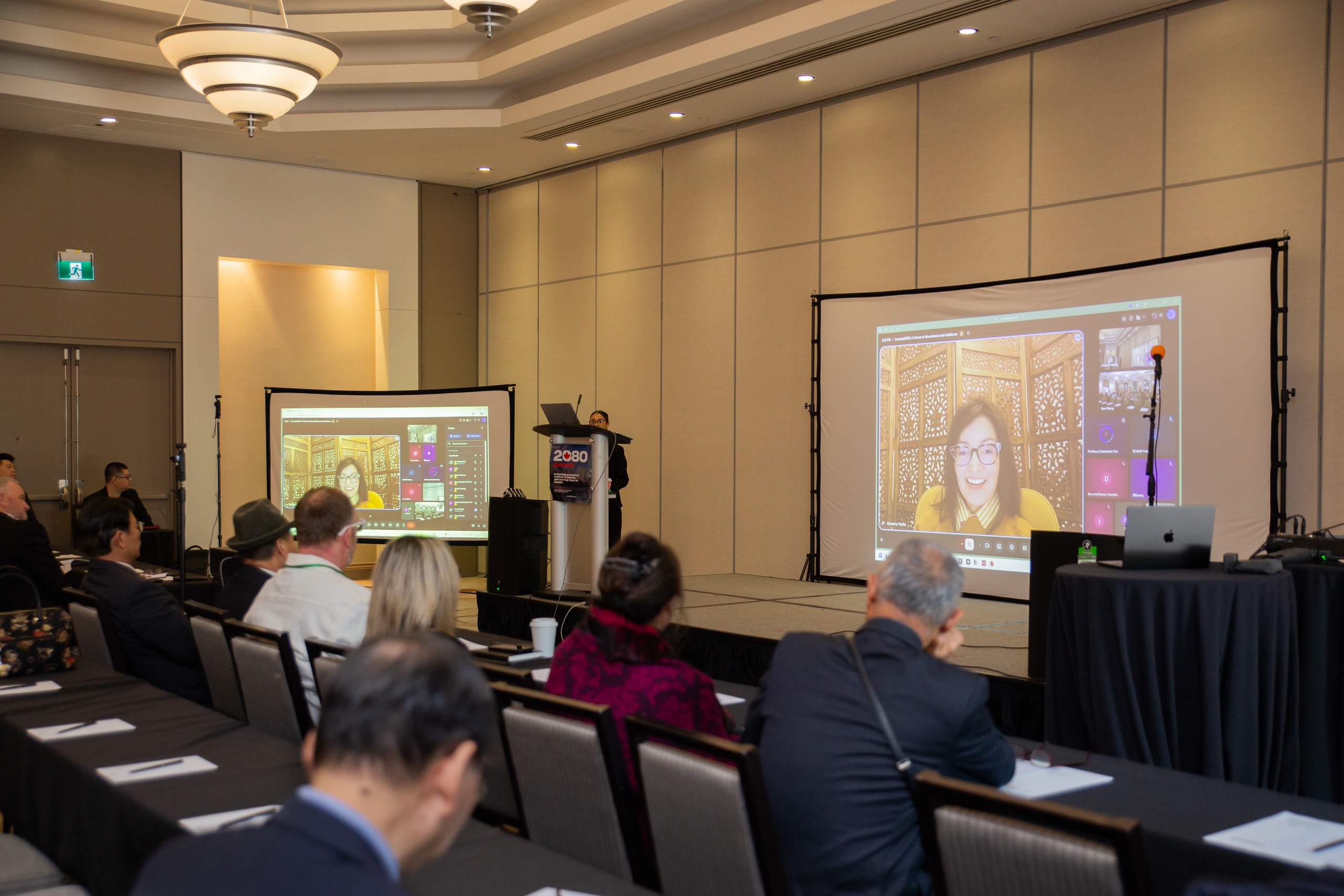 On the screen.