
Kickoff recap · Capacity · 1:55 p.m.
Why do we keep doing what does not work? He has the question, and he will not let it go.
He agreed with Greg Hart, and said he has lived that problem for ten years at the scale of private practice. He is an architect. He has built a business and watched the systems he has to use. Most of them, he said, deliver almost none of the outcome they were set up to deliver.
The field promised a creative practice, a practical one, and problem-solving. What he found was a long argument with where his energy goes. He comes back to Greg's point. Systems deliver what they deliver. Why do we allow that to continue? He does not have the answer. He has the questions.
His clients include some of the largest controllers of commercial property, and some of the largest investors in the Canadian economy and its infrastructure. They still avoid risk, and they still think short-term, even when the asset is supposed to come into its value in 10 or 20 years. That horizon, he said, is not really different from expecting a return in six months.
He asks the people delivering those projects why they believe the work will do what they say, and where their agency is. There is usually no answer.
The work he wants for the country is to unpack why we accept what does not deliver, and to stop accepting it. He called that an innovation mindset: help people become unwilling to accept what is not optimal, and help them encourage that kind of thinking.
Expo 67 comes up in his family. Both of his parents volunteered. He treats it as part of a founding story he wants the country to keep returning to: what is positive, the way Canadians tell a story, and the way they come together when it is difficult.
He described the moment as the negative side of an American hyper-capitalism, and said Canada is already inside it. Data has been extracted. He does not think patience is available anymore. A resilient economy and a resilient society have to be built on many levels. Canada is good at that when it has to be, and it does not do it enough.
His test for a difficult time.
- The power is out for four days, in the depth of winter, and no food is coming in. Would you know what to do?
- How would you know how to talk to people?
- How would you know how to have a conversation about solving the problem? Some people will. Not everybody will.
He pointed to countries that live with obvious security threats, and asked how Canada can be more like them: decentralize, become more resilient, and weave that expectation into the culture of what we do. He knows it is a strange thing for an architect to say. The problems are real, whatever the future looks like. He hopes people start asking, and that an individual can push back when something does not make sense.
Full Transcript
Cleaned up transcripts.
Keynote
So, I think I 100% agree with everything that Greg just said, and I think that over the last 10 years, I've been living those problems at a very small scale, and that is the scale of private practice. I'm an architect, having been through this full cycle of developing a business and trying to understand how effective the systems that I have to engage with really are in delivering the outcomes that they're supposed to be delivering. The reality is most of them deliver virtually none of what is set up as an ideal outcome at the beginning of that process.
So what I've found over those years is that I've constantly had to revisit why that happens and where my energy goes. I can be honest with myself about what I found. The starting principles of going into a field like architecture, which assumes that there's a creative aspect to it, that there is a practical aspect to it, that there's problem-solving, and that all of those things that come into it are what you're really up to, has been a frustrating and interesting process of trying to understand what that means.
You know, when Greg is talking about systems delivering what they're delivering, I completely agree, and I keep coming back to the central question of: why is it that we allow that to continue? Like, what is it about something that doesn't work that keeps us doing things that don't work? I don't have any answers, but I do have a lot of questions. So, I think that's what I'll use my few minutes here for.
One of the interesting things about the work that I've been able to do is that we engage with really large client organizations. These are some of the largest controllers of commercial property and largest investors into the Canadian economy and infrastructure, and they still behave in the same way that we understand them to, which is an incredible aversion to risk, and also a very short-term investment horizon, even for things that look long-term. Like, if you're talking about a piece of property that may come into its value 10 or 20 years from now, that sounds long-term, but it isn't really any different from the thinking of an initial return on an investment that you make that might come to fruition in six months.
So that problem keeps coming up over and over again. Even through asking the people that are also trying to deliver those projects and products, why is it that you think that this is going to do this for you? Where is your agency being exerted into this process? There isn't really usually an answer.
So I think this feels like one of the most important things we need to do in this country: to start unpacking that question of why we accept things that don't really work, or why we engage with things that are not really delivering what we want them to, and that we don't accept that. This is really what I think. I'll mention this as the innovation mindset. How do you help people to arrive at an unwillingness to accept something that is not optimal, and how can you help people to encourage that type of thinking?
Again, if we come back to what other people have said, the idea of Expo 67 is something that comes up in my family a lot. Both of my parents volunteered at Expo 67, and they both were part of that story. I've always had this sense of that as part of the founding story of Canada, of the positive things about the country that I really want to make sure that we're constantly going back to. So I feel like it's really important that we start talking more about what is positive about the country, things that make us able to tell stories in a certain way and able to come together in times of difficulty in a way that maybe other people can't as much as they would like to.
We're in a strange time where we're being confronted with the negative side of an American hyper-capitalism, and we kind of know that we are already part of the matrix, right? We've been having data extracted from us. Sorry, I'm just clicking things here. And we need to try to figure out how we can get everybody in our own ecosystem talking about things that matter now, in a way that we just can't be patient anymore. We have the need to develop a resilient economy and a resilient society on a whole bunch of different levels. We are really good at this when we need to be, but we don't do it enough.
And I'll ask some really simple questions about how well prepared we are for difficult times. Would you know what to do if the power went out for four days in your city in the depth of winter and there was no food coming in? How would you know how to talk to people? How would you know how to have a conversation about problem-solving? There are individuals that are going to be very good at that, but not everybody is good at that.
We can look to countries that are dealing with obvious real security threats and ask: how can we be a little bit more like them in terms of how we can decentralize things, how we can become a little bit more resilient, and how we can build a system that has that as a baseline expectation culturally woven into everything we do?
So that may be a strange thing for an architect to talk about, but at the end of the day, we know that these things are real now. We know that we have to solve all these problems regardless of what the future looks like. And I really hope that we're able to start asking those questions and that, at an individual level, we can start pushing back when something doesn't make sense.
So again, I have no answers to that, but I do have the big question and I can't let it go. So I'll just leave it there.
Panel
Francis Wang asked the questions.
How do we know we are making progress as a country?
I was at a conference on architecture in the UK in February, and there was a presentation from somebody from New York who did a survey. What they were talking about was structuring GIS data so you can actually use it. It occurred to me that we don't have that. If we want to talk about an innovation framework that will help us develop new things, we've got to start getting on the same page about a lot of stuff. Frankly, I advocate for national regulation of professions and everything like that to take out some of those layers of BS that we have to contend with, and all the things we do that don't create any value. We are an administration-heavy country, and while some of it is well-intentioned, not all of it is effective.
What about Monday?
By continuing to do what we're doing now: talk and make sure you don't shy away from having conversations. It's probably irritating for a lot of people because I constantly tell people when I think something isn't working. But there's also this question of choosing what your vector is. For us, that's shifting other things, but that starts by doing it. If you have the discipline to get yourself ready to do something, just go and do it.
At the kickoff
-
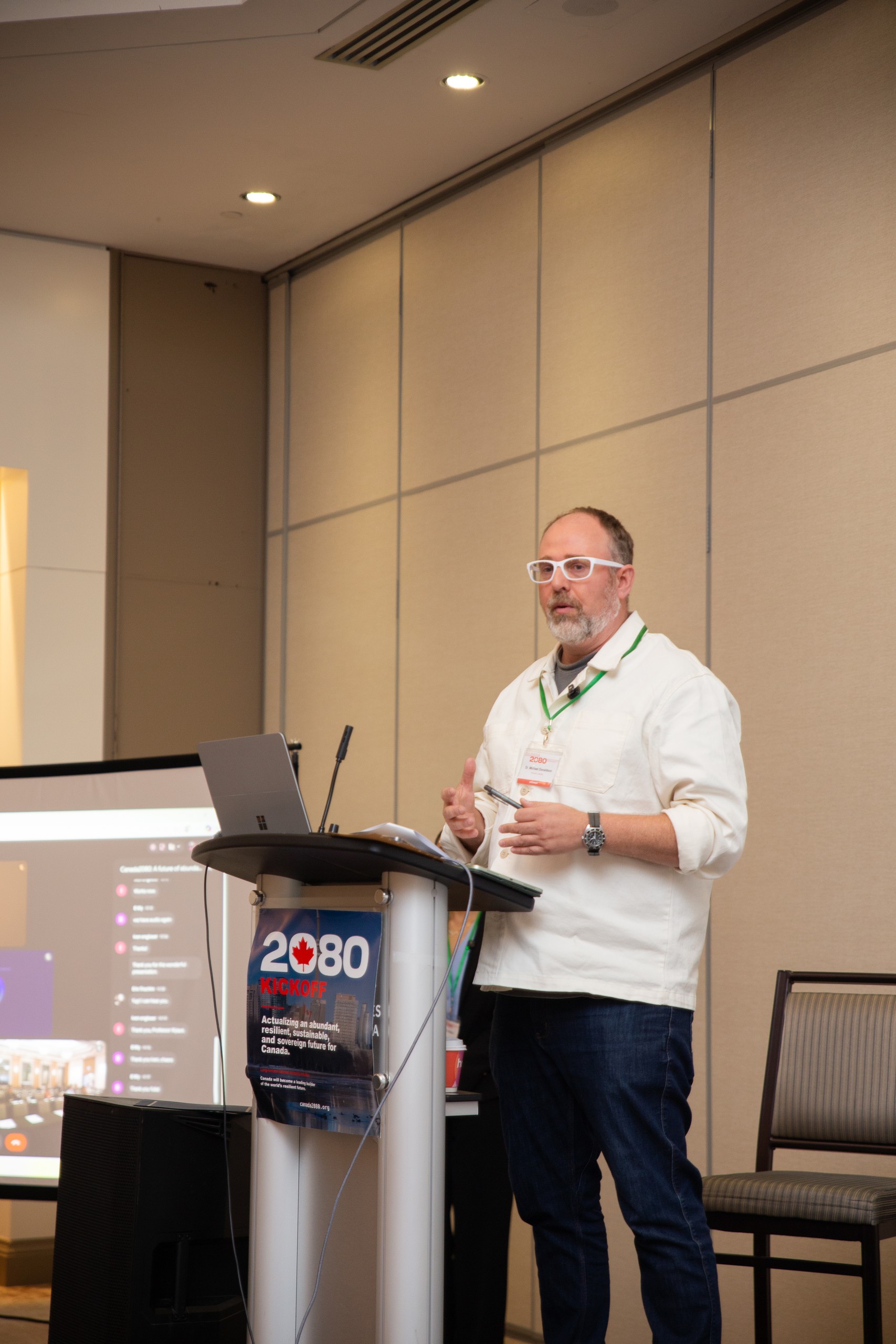 At the podium.