
Kickoff recap · Sovereign AI · 1:20 p.m.
Every summer, she said, wildfire burns an area the size of one Nepal in Alberta's boreal forest.
She had just graduated from Golden Gate University. At work she is a senior director analyst. She kept the talk on what Canada already has, and on one urgent problem that returns every year.
Her numbers: 16.5 million hectares and $9.9 billion at stake each year. Indigenous communities who live there are most affected. The timber industry is hit hardest.
AI, as she used the word, is not only ChatGPT. The field is about 70 years old, and that older practice does not need the compute GPT models or Gemini need. Her research sits in the gap between satellite data and simpler machine learning, and a confirmed account of what is actually at risk.
Two layers in the thesis architecture.
- Pull the data together and clean it. She said that foundation does not need the compute people assume.
- Start with Random Forest on an ordinary computer, then a convolutional network that tries to see the way an eye does, then an ANN that brings the parts together.
The result she wants is a dollar figure for forest-fire exposure. Small, domain-specific language models could do it, drawing on Natural Resources Canada and Statistics Canada. Geospatial data is the remaining hard set. She has a project charter for a master's capstone, for anyone who wants to run it end to end inside a small language model.
The doctorate, she said, was not the point. The point is a usable picture of what is at stake each year, built as much as possible on data held here. Some Copernicus satellite data from Europe may still be needed.
Full Transcript
Cleaned up transcripts.
Keynote
Good afternoon, everyone. It's great to be here. My name is Dr Sudarshana. I just graduated from Golden Gate University, and at work, I'm a senior director analyst, as Francis mentioned.
I'm keeping it very crisp and aligned to what Francis mentioned around Canada becoming stronger with what we have right now, pivoting on the materials that we have and at the same time trying to tackle the challenges that we are posed with every year. My research tried to address one of the urgent things that happens every year, focused on the boreal forest of Alberta.
Geographically for context, every year we burn the area of one Nepal during our summer season because of wildfires. The people most impacted are our Indigenous communities who stay there. Industry-wise, the timber industry is hit the worst.
On the other side, we hear a lot of things happening with AI. Let me keep it very simple here: when I say AI, it is not just ChatGPT. We have been doing AI for 70 years now, so let's start from there. That does not require the type of compute that GPT models or Gemini require. That is where the research intervention is. I will quickly go over some context to show you the numbers: 16.5 million hectares and $9.9 billion are at stake every year. The research tries to bridge the gap between satellite data, AI, machine learning, and probabilistic output on the left-hand side, and the right-hand side where we need a confirmed way to understand what is actually at risk. That is exactly the research intervention.
This is a high-level architecture proposed as part of the thesis. It starts with the top layer where we pull data together. That is the foundation, and once we clean the data, that does not require the amount of compute we always thought it would. The second layer is the intelligence layer. We start with very simple, basic machine learning without going to any GPTs. We start with Random Forest, which can easily run on PC, and then move to CNN (convolutional neural network), which tries to replicate the way our eyes see and perceive. Then an ANN brings it all together.
What it tries to solve is how we can account for the amount of exposure we have due to forest fires and arrive at calculated dollar figures. To implement that, it could be done using small language models, domain-specific language models, and most importantly, pulling together datasets from Natural Resources Canada and Statistics Canada. The only other challenging dataset we have is geospatial data. If we can figure out how best to pull geospatial data together, I would love to implement it as a capstone project. If anyone in a Master's program wants to implement it as a capstone project, I have a project charter outlining how to sequence these activities so we can see what end-to-end implementation within a small language model looks like.
The idea here was not just to pursue a doctorate in AI or machine learning. The idea was to make it as applicable and sovereign as possible by leveraging in-house data. We may rely on some European satellite datasets coming from Copernicus, but that is all we would need to really implement it and have a clearer picture of what goes at stake every year and how we can protect it.
I am happy to answer any questions you have and to continue the conversation after we wrap up. Thank you.
Panel
Francis Wang asked the questions.
What is the first distinctive thing we can do by borrowing from patterns abroad? What are the patterns we can accommodate in Canada?
Dr Sudarshana Bhattacharya.
Another thing that I'm seeing happening a lot, especially in the Asia-Pacific, is starting with not so many billions of parameters. Start with a small language model and go very domain-specific, because there are certain domains where the data is cleaner. It is always easier to start with those domains and train your own model. Train it in your own backyard and get it ready. In that way, you are not losing on compute. You don't have to use anything that you have to procure from outside. Small, domain-specific, homegrown models would be one of the ways to think about it.
What evidence should decision-makers demand before calling an AI deployment here safe, secure, trusted, or publicly beneficial?
Dr Sudarshana Bhattacharya.
Governance, complemented with observability and provenance, is also very important. I need to understand why certain decisions were made and what really triggered that kind of decision. If I go back to the banking example, and a certain part of the community is not getting a benefit, say a home loan or any type of mortgage, why is that happening? Observability and a clear decision provenance give that clarity, and that runs in parallel with governance.
Even when we do our best with whatever we deploy, threat vectors expand every day. It is very hard to stay a step ahead. This is where I see AI security platforms as one way to keep watching for bad actors trying to infringe a system.
At the kickoff
-
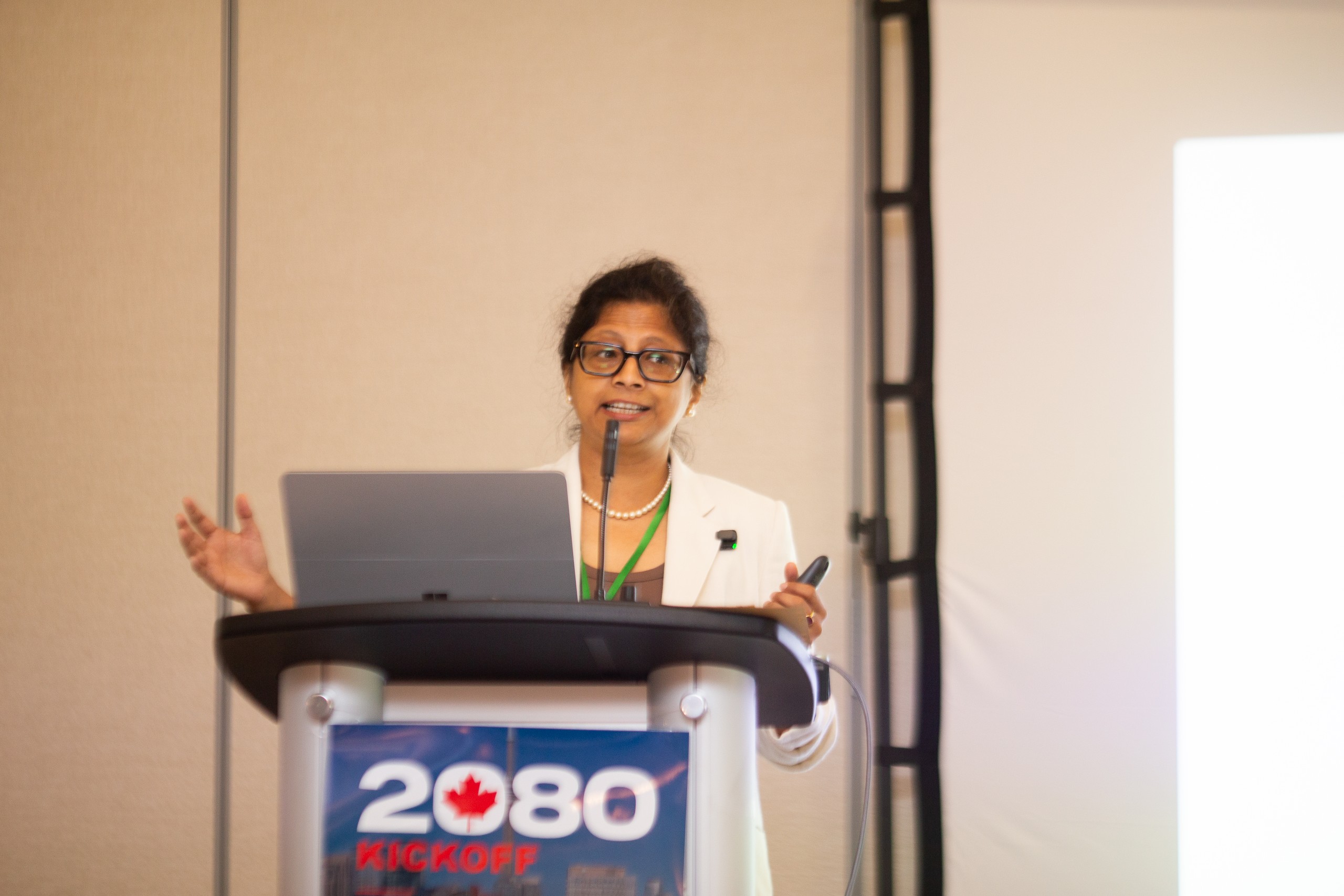 On wildfire exposure in Alberta's boreal forest.