
Kickoff recap · Capacity · 1:55 p.m.
She does not think the build waits until 2080. With the technology she sees, it is 2040 or 2050.
She was travelling and had not planned a formal presentation. She thanked Francis for the invitation and spoke from more than 15 years of building industrial projects.
Canada, she said, already has the land, the talent, the technology, and the manufacturing resources to lead in building infrastructure. That runs from the computing available for AI infrastructure to the construction available to build it.
A data centre, in her comparison, has less environmental effect than light industry. She named a bottling plant and an Amazon distribution centre. Noise is lower than the distribution centre. With closed-loop systems, water use is about the same as an office. Contamination is almost nothing.
She also sees a shift in real estate and development, from Class A buildings alone toward cohesive, high-end campuses the community is part of. Jobs are created. Buffer zones are provided. The building is done with the community, and with less impact on the environment.
For her, a data centre is no different from any other industrial facility. It has to be done right. Canada has what that takes.
Full Transcript
Cleaned up transcripts.
Keynote
Hi everyone, can you hear me well?
Yeah, I wasn't ready to present anything, to be honest. I'm travelling very much this week and next week. I will share my experience. Thank you, Francis, for inviting me to this great event. I think we have a strong voice. You put it in the perspective of 2080. I think with all the technology that is unfolding, it is actually a very dynamic unfolding perspective. I think it won't be 2080. I think it will be 2040 or 2050 with everything that I see on the market. Starting from the technology that is actually available for computing for the AI infrastructure, to what's available for construction purposes to build this infrastructure.
To be very, very honest, I truly believe that in Canada, we have everything. We have land, we have talent, we have smart people and technology, and we have manufacturing resources. We have land, we have everything to proceed and to be leaders in building infrastructure.
I know that there's a lot of speculative discussion about AI infrastructure and data centres. But I'm very thankful that I have more than 15 years of experience building industrial projects and industrial infrastructure. I truly believe that AI or data centres, a lot of people are talking about the environment, you know, how it affects the environment. If you compare a data centre with any other manufacturing facility, not even a heavy-duty manufacturing facility, but something like a bottling factory, like Coca-Cola, or an Amazon distribution centre, you will be very surprised that, compared to these light industrial facilities, data centres actually provide less environmental effect.
Yes, there is noise, but it's less than any Amazon distribution centre. In terms of water, with the closed-loop systems and the technology available now, the impact will be the same as any office's water usage. As for contamination, it's almost nothing.
I also see that there is a big shift from the real estate and developers' perspective, moving from not only Class A buildings but to cohesive, high-end, and community-involved campuses. What I mean by that is developing big industrial and high-tech campuses where the community is involved, jobs are created, proper buffer zones are provided, and building is done right with community involvement and less impact on the environment.
For me, data centres are no different than any other industrial facility. We just need to make it right. I truly believe that Canada has everything to develop this infrastructure. Thank you.
Panel
Francis Wang asked the questions.
How do we know we are making progress as a country?
Can I add to this point? I also think that from the design perspective and architecture perspective: labour harmonization, requirements harmonization, and construction development charges dropping a little bit will help developers do it faster, cohesive, and easier. I think that's fine for parts of the country.
Sounds strong. Disruption always comes from the outside. I think it's good news.
What about Monday?
I think for a lot of businesses, it's learning to be comfortable with being uncomfortable. Through all the new actual measuring points, resilience is a new measuring point, to be resilient as a business or practice. Every day, look for new ways of doing stuff. Where the constraints are, that opens up opportunity to be more resilient and efficient, and to align with the idea of moving forward outside your comfort zone.
At the kickoff
-
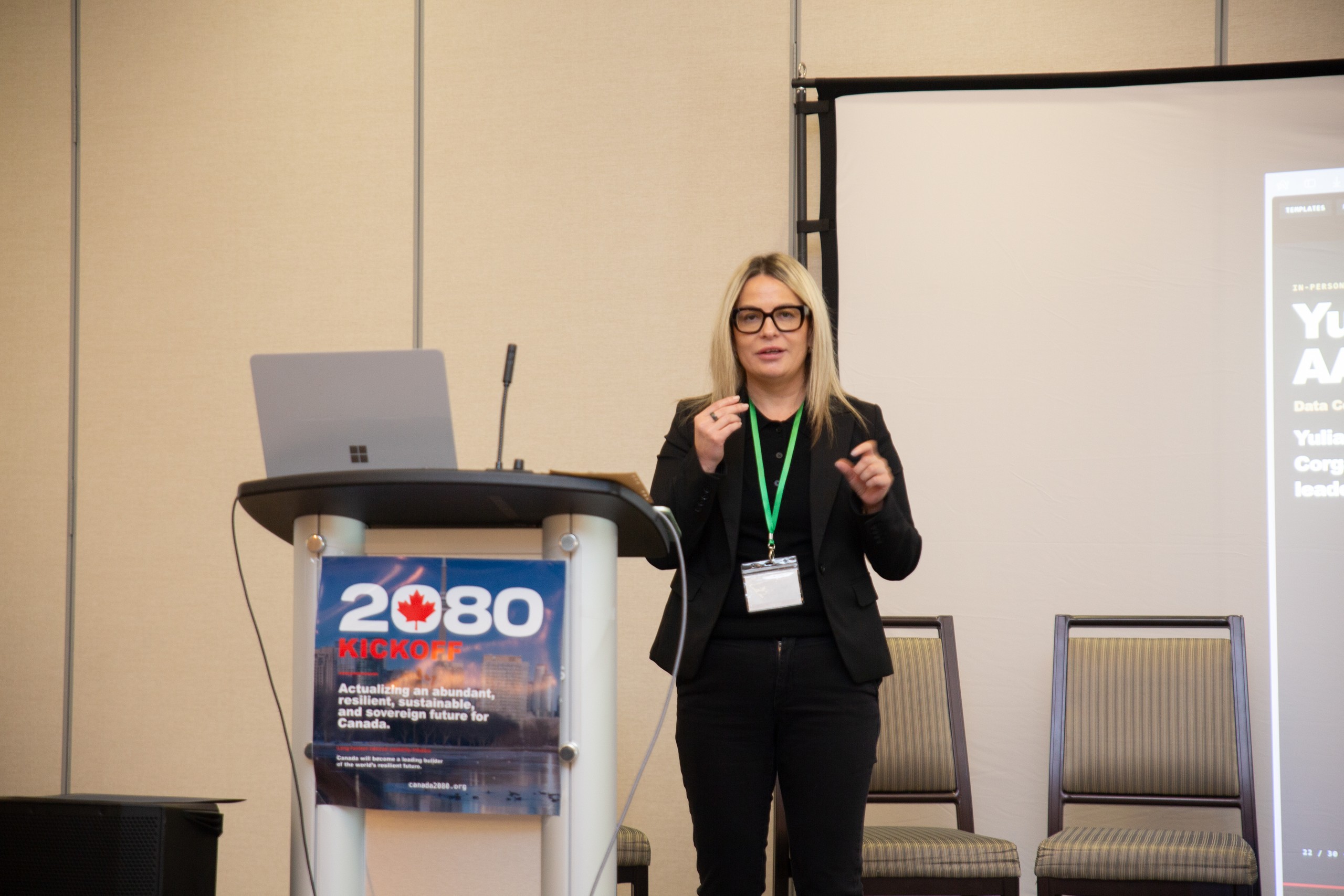 On data centres as a high-tech industrial campus.